
Photo courtesy of Whiteshark Photography
Behind the curtain of the “Ever-Changing Hockey League” (ECHL)
By Eva Hallman
“We went to the rink, it was an eerie day,” recalled Todd Skirving, current Kalamazoo Wings forward, when remembering the day he found out his team no longer existed in the ECHL.
“I put feelers out to different people in the organization to make sure they would get a hold of me ASAP and then it just went very quiet. I had this bad feeling. We went through practice, and it was cut short. No one [on the team] had anything in them. It was just, ‘oh boy, like what's gonna happen?’”
A friend delivered the news to Skirving that the Newfoundland Growlers were no longer a
team in the ECHL, effective immediately.
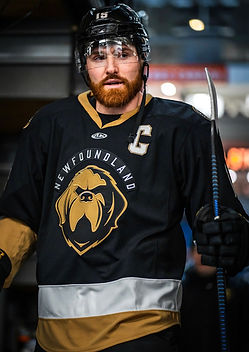
Skirving was the captain of the 2023-2024 Newfoundland Growlers, a team that ceased operations on April 2, 2024, just two weeks before the season would formally end. All players became free agents on that day. Some players found teams to join, others did not.
Skirving was picked up by the Florida Everblades, who went on to win the 2024 Kelly Cup Championship. “I picked the right [team], thankfully, because then I went from having probably one of the worst days of my life to some of the best,” Skirving said. “It was an absolute rollercoaster of emotions. There's no way to explain it.”

From worst days of his life, to some of the best. Photos courtesy of Todd Skirving
Founded in 1988, the ECHL is a developmental hockey league based mainly in the United States with one team in Canada. The “AA” league currently has 30 teams, each with its own American Hockey League (AHL) and National Hockey League (NHL) affiliate. Each team competes for the prized Kelly Cup, with the 72-game regular season stretching from October to April.
Minor league hockey is seen as a spectacle, a form of entertainment. The ice is their stage, with players taking on their assigned roles and personas. Behind the curtain lies a different story, one less glamorous than it may appear. From blindsiding trades, season-ending injuries and the rarity of seeing loved ones, the pressure of minor league hockey goes beyond the ice.
When Stick meets Glove
There is no exact telling when the stick falls into a hockey player's hand. Legend has it, they were just born with it, especially the Canadians.
Taylor Gauthier is one of those Canadians, a goaltender from Calgary, Alberta, who experienced Canadian junior hockey and instantly fell in love with the game.

The 2023-2024 ECHL Goaltender of the Year. Photos courtesy of the Wheeling Nailers
“I think like everyone in Canada growing up, hockey is kind of bred into you,” Gauthier said. He signed with the Pittsburgh Penguins and assigned to the ECHL’s Wheeling Nailers.
“It started by just going to junior hockey games with my family, where my uncle had season tickets. I just fell in love with the game at such a young age.”
Born into life on the rink often leads to the dream of reaching the NHL, a goal shared by nearly every player.
“I think obviously everyone's dream growing up is to play in the NHL,” Gauthier said. “I don't think that's changed for me yet.”
Victor Hadfield was born into the life of “the show,” a term coined for the NHL. His grandpa, Vic Hadfield, played 1,002 games in the NHL. The former New York Rangers captain retired in 1977, and his jersey was retired in Madison Square Garden in 2018.
Some call Vic their favorite player of all time; Victor calls him grandpa. This bond shaped him on and off the ice.
“There's that little bit of added pressure [to perform] just because of how successful he was,” Hadfield said. “We share the same name, so there’s that as well, but at the same time, it's cool to have that pressure. It’s cool to be able to say he's my grandpa, and I can call him every day.”
Despite their dreams of “the show,” it’s the love of the sport that keeps players in the game. Anthony Petruzzelli once dreamed of the NHL, but after a stint in the AHL, he realized that was his “NHL.”

Same name, same passion, different generation. Photo courtesy of Victor Hadfield
“Everyone wants to be at that top, top level,” said Petruzzelli. “I think over the years, being in the minor leagues for so long, things kind of change the older you get. I remember still lining up my first face-off [in the AHL], I look over, and it's Kris Versteeg, two-time Stanley Cup champion with the Chicago Blackhawks. Looking back now, that was kind of my NHL.”
Playing hockey appears glamorous, but there’s always the business side. ECHL players have a one-year contract, but it may seem more like a day-to-day contract. Hockey is an unforgiving sport. It takes more than it can give, especially in the minor league system.
Behind the Curtain
Within the 72+ game season, fans see the players a lot. From community events to the games themselves, fans are invested in the players on and off the ice. However, there’s more that happens behind the locker room doors. After all, minor league teams are a business, and they have to make harsh business decisions like trades at the drop of a hat.
“I had no idea I was being traded,” said Victor Hadfield, who was playing with the South Carolina Stingrays at the time.
“I showed up at the rink on a game day, like I think I'm in the lineup. The coach calls me in and just goes, ‘yeah, we're trading you to Jacksonville, and they want you to be there tonight.’ I was in shock. As I was walking out of the parking lot, I sat down in the car, and I threw up because I was just like, ‘what just happened?’”
Thomas Farrell experienced a similar blindside, but looking back, is thankful for it. He is still on the team he was traded to, and hopes to make a run at the 2026 Kelly Cup Championship.

“I thought that it was something that came out of nowhere,” Farrell said. “It's just like one of those things where you're going into the unknown. You've heard great things [about the team], but you don't know how it's going to fit for you.”
Trades can sometimes be hours before puck drop and players are sent hundreds of miles away to play with a group of players they’ve never met before. Trades impact not just the players, but the coaches who have to make them.
Farrell in the Mavericks' affiliation night jerseys. Photo courtesy of Thomas Farrell
Former Indy Fuel assistant coach Geoff Schomogyi described the restless night before tough decisions. “In my coaching career, I had sleepless nights, knowing that we’re going to have to make some of those hard decisions, because there obviously is that human element to [the job],” Schomogyi said.
Decisions in the minor leagues have a trickle-down effect, especially for goaltenders. There are fewer than ten goaltenders in an organization between three teams. If one gets injured or traded, the domino effect of calling one up begins. From a fan perspective, losing your favorite goalie stinks, and you are unsure when they will return and the players themselves are unsure too.
Ben Gaudreau, currently signed as a two-way goaltender with the AHL’s Laval Rocket, described the uncertainty of being called up from the ECHL to the AHL.
“Last year I was going up and down [between the Rockford IceHogs and Indy Fuel] almost every other week,” Gaudreau said. “It's tough. I mean, you really don't know where you're going to be. I try to plan groceries, plan stuff with the guys. Just the little things that you don't really think about.”
He recalls the first time he got called up from the ECHL Indy Fuel to the AHL Rockford IceHogs.
“It was like right after I did my first grocery trip … I just spent $300. I think half of that probably went bad. When you go up [to the AHL], usually you're staying in a hotel. Sometimes that hotel doesn't have pots, pans, a stove or anything to cook on; so you're eating out the entire time you're up.”

Gauthier had a similar experience for his first AHL call-up.
“I got called up [the day after Christmas], and they told me to pack a bag for a couple of weeks,” Gauthier said. “I packed a carry-on bag and maybe a suit or two. Five months later, I was still up there. So that was my big, ‘you don't know what's going to happen [moment]’. I ended up playing 20 games up there [that season].”
There’s the uncertainty of not knowing where you are playing next, and then there's the uncertainty of not knowing when you will see your family.
Gaudreau suits up for the Lions. Photo courtesy of Ben Gaudreau

Gaudreau and his girlfriend out hunting. Photo courtesy of Ben Gaudreau
“This year was the first year I've been home for Christmas in like six years,” said Hadfield.
Gaudreau did not go home once last season when he played for the Indy Fuel. His only two options were a 12-hour drive or an $800 flight, but now his current team is half the distance to home. He’s able to sneak away for long weekends to see his family and girlfriend, but most importantly, relax his mind.
“I haven't been home for Christmas since I was 19 [currently 25], " said Gauthier. I'm 31 hours away from home, so there's not a whole lot of opportunity for me to go home or for my family to come out here. It’s really hard for someone in my position to get that piece of home. You just rely on your teammates and have a family-like team.”
However, a family-like team can only go so far. Especially thousands of miles away from home and given the unpredictability of the sport.
Things You Can’t Control
Nathan Burke, a native of Scottsdale, Arizona, signed overseas last season with the Pioneers Vorarlberg in Austria after two years in the ECHL.
“Europe offers better salaries and better contracts, and that was something ultimately that was important to me,” said Burke. “I wanted to feel like I’m making some progress in my life so I took the jump to go overseas, which came with its own set of challenges.”
Those challenges included tearing his ACL. Burke played less than half of the ICEHL season in Austria due to the injury. Despite being in a new city and traveling abroad, which he always wanted to do, he wanted to share it with those he loved.
“I can go explore and go to coffee shops, but it's just me doing it alone,” said Burke. “Yes, there's peace in that, but at the end of the day, I think life's meant to be spent with people that you care about, so that's where it gets hard.”
Skirving shared on Instagram on March 12 that his season was over due to a shoulder labrum injury. In back-to-back years, his season ended early because of injury. This time, he had to get surgery.
"So it took me about a week to kind of really process it and understand it,” Skirving said. “I could sit here and have a bum shoulder for the rest of my life, or I could just [get surgery]. Now it's just taking it day by day, trying to battle those mental battles and get healthy again.”

Skriving announced his season ending injury on March 12. Photo courtesy of @toddskirving on Instagram
Health and safety were one of the biggest conversations between the Professional Hockey Player Association (PHPA) and ECHL for the recent Collective Bargaining Agreement (CBA).
After years of record-breaking success for the league, the players wanted growth, too. On December 26, 2026, the PHPA went on a four-day strike, forcing the postponement of 41 games across the ECHL. Skirving is a member of the PHPA’s executive committee and was a part of the negotiation process.
The highlights of the new CBA include a standard for safer equipment, ensuring players have helmets that fit them, an increase in pay, mandatory off days, limiting travel for back-to-back games, insurance in the off-season, restructured holiday travel, an increase in per diem, and more.
“People were saying ‘we’re such a lower league that we shouldn't deserve to be getting any extra money and stuff like that,’” said Thomas Farrell, a PHPA team representative. “We're not playing in this league because we're trying to make a whole lot of money. It's all about the love of the game for a commitment to something that’s bigger than yourself.”
The new CBA will run through the 2029-2030 season, with committees already preparing for the next negotiation.
Is there an after hockey?
Nathan Burke has his master's degree in business administration and specializes in quality systems. Despite his love for hockey, he has struggled with the discrepancy of how much money he is making playing hockey versus how much he could make with his degree.
“Hockey has to come to an end at some point; that's kind of just inevitable, you can't play forever,” said Burke.
There is also the element of “watching life go by,” outside the hockey bubble.
“I just removed all of myself from social media,” Burke said. “As much as I love seeing what people are up to, it's hard. Comparison is the thief of joy.”

A piece of home from miles away. Photo courtesy of Nathan Burke
While some are still finalizing what life after hockey exactly looks like, for Colin Bilek and Thomas Farrell, their post-hockey plans are already set in stone.
Both Bilek and Farrell attended the United States Military Academy at West Point and played hockey together there.
After attending a military academy, there is a service requirement post-graduation. Both players got the opportunity to play professional hockey before they head to service.
Farrell branched into field artillery post-grad and renews every year to continue playing hockey, but is grateful to have something secured for after.
“The Army isn't going to be going away anytime soon,” Farrell said. “It is a sense of comfort as I have job security, something to fall back on, and something that I’m more than happy to be a part of.”

Bilek, a forward playing for the Kalamazoo Wings in his home state of Michigan, also branched into field artillery and will become a second lieutenant when he joins the active military.
“It's definitely something I'm excited about,” Bilek said about his future service. “I don't think a lot of guys in the Army got to go play professional sports, and then go serve. So I'm pretty excited to see that new chapter of my life [when the time comes].”
Bilek wore the "C" for the Army from 2020-2022. Photo courtesy of Colin Bilek
For some, that time has come, embarking on a post-hockey future. This year, ECHL veteran Darby Llewellyn decided to retire from playing professional hockey, but not the hockey world itself.
“I've always really enjoyed officiating," Llewellyn said "When I was a little kid ... I used to try and officiate games on the side of the rink when my brother was playing. It makes sense that it's come full circle and now that's the route I want to get to.”
Darby and his wife, Caitlyn, met in 2020. They have been together through six teams, and most recently had their first child mid-season last year. Even through the chaos and uncertainty of hockey, they have each other and their village.
“I truthfully don't think I would have been able to survive those first few weeks [with having a newborn], and I mean even now, without the support system,” Caitlyn said, reflecting on being a new mom during hockey season. “Thankful for the people that kept me sane and helped me out when I really needed it.”
Last year, in peak hockey season, Darby and Caitlyn welcomed their first child together. Darby was warming up for a game when he was notified that his wife needed to go to the hospital. He scurried out of the arena an hour before puck drop. A healthy baby boy was born on the 2nd, and Darby had to return to playing days later on the 7th
“We're going through it together, and there can't be anything more powerful than being able to look each other in the eye and say, we're going to do this,” Darby said.

The happy family of three. Photo courtesy of Caitlyn Llewellyn
Every hockey journey is never the same. Some continue to chase dreams of the NHL, while others chase dreams of family.
Gauthier is still one of those “some” chasing, and achieving his NHL dream. On Easter Sunday, he was called up to the National Hockey League to be the backup goaltender for the Pittsburgh Penguins.
“I didn’t expect the first time getting called up to the NHL to be in this scenario," Gauthier told reporters after the game. “But I’m so grateful for the experience … it’s been a dream come true.”

Gauthier on Easter Sunday in the NHL. Photo courtesy of the Pittsbugh Penguins.
Even through the uncertainty of hockey, the show must go on. Missing family? Aching from the game the day before? Traded? It’s time to play in front of thousands of fans who have no clue what is going on behind the scenes.
The stadium reaches 114 decibels as the thousands of fans rise and cheer for their hometown team. Contrasting jerseys and focused eyes meet as the teams skate towards center ice to await the puck drop.
Internal and external noise fills the players’ heads as they stand face-to-face with their opponent.
The lights are on.
The music is cut.
The puck is dropped.